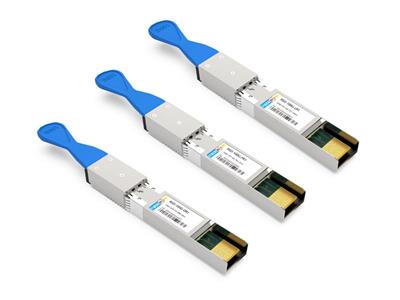
Ante la creciente demanda de interconexión de centros de datos, los transceptores ópticos de longitud de onda única compatibles con el estándar Lambda MSA de 100 G se han convertido en la opción preferida gracias a sus ventajas de alta densidad, bajo consumo de energía y bajo coste. Basados en los tres transceptores ópticos encapsulados SFP56-DD de nuestra empresa, el
SFP-DD DR1 de 100 G
(RSD-100G-DR1),
SFP-DD FR1 de 100 G
(RSD-100G-FR1) y
SFP-DD LR1 de 100 G
(RSD-100G-LR1), este documento realiza una comparación exhaustiva de sus características técnicas para ayudarlo a tomar la decisión óptima para escenarios de aplicación específicos.
|
Nombre del producto
|
Número de modelo
|
Descripción del Producto
|
|
SFP-DD DR1 de 100 G
|
RSD-100G-DR1
|
SFP56-DD DR1, 106,25 Gb/s, 500 m, EML+PIN, SMF, LC doble
|
|
SFP-DD FR1 de 100 G
|
RSD-100G-FR1
|
SFP56-DD FR1, 106,25 Gb/s, 2 km, EML+PIN, SMF, LC doble
|
|
SFP-DD LR1 de 100 G
|
RSD-100G-LR1
|
SFP56-DD LR1, 106,25 Gb/s, 10 km, EML+PIN, SMF, LC doble
|
I. Comparación completa de las especificaciones principales
Los tres transceptores cumplen con los estándares SFP56-DD MSA e IEEE802.3cu y utilizan la tecnología de modulación PAM4 para convertir dos señales eléctricas de 53 Gbps en una señal óptica de 106 Gbps. Comparten el mismo factor de forma, interfaz LC dúplex y temperatura de funcionamiento (0-70 °C), pero presentan diferencias significativas en la distancia de transmisión y los parámetros ópticos clave.
|
Característica
|
RSD-100G-DR1
|
RSD-100G-FR1
|
RSD-100G-LR1
|
|
Distancia máxima de transmisión
|
500 metros
|
2 kilómetros
|
10 kilómetros
|
|
Longitud de onda central
|
1311 nm (1304,5-1317,5 nm)
|
1311 nm (1304,5-1317,5 nm)
|
1311 nm (1304,5-1317,5 nm)
|
|
Tipo de transmisor
|
EML refrigerado
|
EML refrigerado
|
EML refrigerado
|
|
Tipo de receptor
|
ALFILER
|
ALFILER
|
ALFILER
|
|
Consumo máximo de energía
|
3,5 W
|
3,5 W
|
3,5 W
|
|
Potencia óptica transmitida promedio
|
-2,6~4,0 dBm
|
-2,4 ~ 4,0 dBm
|
-1,4 ~ 4,5 dBm
|
|
Sensibilidad del receptor
|
-4,0 dBm
|
-4,5 dBm
|
-6,1 dBm
|
|
Sensibilidad del receptor
|
-5,6~4,5 dBm
|
-6,4 ~ 4,5 dBm
|
-7,7 ~ 4,5 dBm
|
|
Escenarios típicos de aplicación
|
Interconexión ToR de alcance ultracorto en salas de informática y clústeres de IA
|
Interconexión de corto alcance en edificios, agregación de redes de campus
|
Redes de campus de área amplia, acceso metropolitano, DCI de largo alcance
|
II. Comparación detallada de características
1. Distancia de transmisión y presupuesto de enlace
Ésta es la diferencia fundamental entre los tres transceptores, que determina directamente la estabilidad del enlace.
RSD-100G-DR1 (500 m)
-
Posicionamiento: Optimizado para distancias ultracortas, normalmente se utiliza para interconexión dentro del mismo gabinete o entre gabinetes adyacentes.
-
Rendimiento: La sensibilidad del receptor es de -4,0 dBm. Si bien su potencia mínima de transmisión (-2,6 dBm) es ligeramente inferior a la del FR1, la atenuación de la fibra es insignificante gracias a la distancia de transmisión ultracorta, lo que cumple plenamente los requisitos de presupuesto de enlace en un radio de 500 m.
Nota: DR1 es la solución de corto alcance más rentable. Si la longitud del enlace se controla estrictamente dentro de los 500 metros (p. ej., cableado de alta densidad en grandes centros de datos), DR1 puede proporcionar la misma velocidad de datos que FR1/LR1 y, por lo general, ofrece mejores ventajas de coste o optimizaciones de compatibilidad específicas.
RSD-100G-FR1 (2 km)
-
Posicionamiento: Un transceptor de corto alcance estándar que cubre la mayoría de los escenarios dentro de los centros de datos.
-
Rendimiento: La sensibilidad del receptor se mejora a -4,5 dBm, lo que permite una transmisión estable hasta 2 kilómetros.
Nota: Forzar el uso de DR1 para enlaces que superen los 500 m puede provocar un aumento brusco en la tasa de error de bits debido a un margen de potencia óptica insuficiente.
RSD-100G-LR1 (10 km)
-
Posicionamiento: Un buque insignia para distancias medias y largas con la mayor resistencia a la atenuación.
-
Rendimiento: Tiene la mejor sensibilidad del receptor (-6,1 dBm) y la potencia de transmisión mínima más alta (-1,4 dBm) entre los tres.
Nota: LR1 ofrece la máxima redundancia de presupuesto de enlace. Incluso si la distancia de despliegue real es de tan solo 500 metros o 1 kilómetro, si el enlace de fibra presenta una gran cantidad de empalmes por fusión, conectores obsoletos o una fibra de mala calidad, seleccionar LR1 ofrece la garantía más fiable y evita interrupciones de la comunicación causadas por pérdidas excesivas en el enlace.
2. Consumo de energía y relación de eficiencia energética
El consumo máximo de energía de los tres transceptores es de alrededor de 3,5 W.
-
Análisis de eficiencia energética: Con el mismo consumo de energía, LR1 proporciona una distancia de transmisión 20 veces mayor que la de DR1.
-
Estrategia de selección:
-
Para los centros de datos de hiperescala, si el 90 % de los enlaces están dentro de los 100 m, la implementación masiva de DR1 puede ofrecer más ventajas en los costos de adquisición (sujeto a los precios del proveedor) y puede reducir levemente la carga térmica del sistema (algunas implementaciones de DR1 pueden tener un consumo de energía levemente menor).
-
Si se considera la expansión futura de la topología de la red (por ejemplo, de conectividad dentro del rack a conectividad entre salas), la implementación directa de LR1 puede evitar costos de construcción y riesgos de interrupción del servicio causados por el reemplazo del transceptor en el futuro, logrando "una implementación sin preocupaciones durante una década".
3. Compatibilidad y estandarización
-
Estándares de protocolo: los tres son totalmente compatibles con los estándares 100G Lambda MSA e IEEE802.3cu.
-
Interoperabilidad:
-
DR1, FR1 y LR1 son generalmente interoperables siempre que la longitud del enlace real esté dentro del rango nominal del transceptor más corto y la potencia óptica esté dentro del rango permitido del extremo receptor (sin sobrecarga y no inferior a la sensibilidad).
-
Ejemplo: Conectar una fibra de 300m con transceptores LR1 en ambos extremos es completamente normal; conectar una fibra de 400m con un DR1 en un extremo y un LR1 en el otro generalmente funciona, pero es necesario asegurarse de que la potencia óptica recibida en el extremo DR1 no sea inferior a -4,0 dBm.
-
Monitoreo de diagnóstico digital (DDM): Funciones de diagnóstico digital completas integradas que monitorean en tiempo real la temperatura, el voltaje, la potencia óptica transmitida/recibida y la corriente de polarización a través de la interfaz I2C, lo que facilita la resolución de problemas y la gestión del rendimiento para el personal de operación y mantenimiento.
-
Soporte FEC: Todos admiten KP-FEC (utilizado para lograr la distancia nominal) y KR-FEC es opcional en algunos escenarios.
4. Tecnología de procesamiento de señales
Los tres adoptan la tecnología PAM4 (modulación de amplitud de pulso de 4 niveles):
-
Interfaz eléctrica: 2 x 53,125 Gb/s PAM4 (100GAUI-2).
-
Interfaz óptica: 1 PAM4 de 106,25 Gb/s. Este diseño aprovecha eficazmente el ancho de banda de una sola longitud de onda y logra el doble de velocidad de datos a la misma velocidad en baudios que la modulación NRZ tradicional, lo que mejora considerablemente la eficiencia espectral.
III. Escenarios de aplicación
RSD-100G-DR1 (500 m)
-
Centros de datos de ultra alta densidad: adecuados para la interconexión de conmutadores Top of Rack (ToR) dentro de la misma fila de gabinetes o entre filas adyacentes.
-
Clústeres de IA/computación de alto rendimiento: conexiones de alta velocidad y alcance ultracorto entre servidores y conmutadores en escenarios de latencia crítica.
-
Proyectos de corto alcance sensibles a los costos: sirve como la solución de longitud de onda única de 100G más rentable cuando se confirma que la distancia no supera los 500 metros y la calidad de la fibra es buena.
RSD-100G-FR1 (2 km)
-
Interconexión en grandes edificios: Conexión del Cuadro de Distribución Intermedio (CDI) y el Cuadro de Distribución Principal (CDP) en diferentes plantas del mismo edificio.
-
Capa de agregación de red de campus: Adecuada para conexiones entre edificios en campus de tamaño medio (con una distancia de 500 m-2 km).
-
Interconexión estándar de centros de datos: Interconexión rutinaria entre diferentes salas de cómputo de un mismo campus, para escenarios donde la distancia supera los 500m pero es menor a 10km.
RSD-100G-LR1 (10 km)
-
Redes de campus de área amplia: conectan múltiples edificios de oficinas o plantas industriales dispersos geográficamente (2 km a 10 km).
-
Capa de acceso a red de área metropolitana: enlaces de acceso de 100G para operadores o redes empresariales de gran tamaño.
-
Entornos de enlace con alta pérdida: Muy recomendable. Incluso para distancias cortas (p. ej., <500 m), si el enlace de fibra es antiguo, tiene numerosos conectores o presenta una alta pérdida de divisor, el alto presupuesto de potencia de LR1 es la única opción para garantizar la estabilidad del enlace.
-
Reserva de expansión futura: Escenarios en los que la distancia específica es incierta en la etapa de planificación inicial o se espera una expansión de larga distancia en el futuro.
IV. Conclusión y recomendaciones
Al elegir entre DR1, FR1 y LR1, consulte la siguiente lógica de toma de decisiones:
|
Requerimiento real
|
Modelo recomendado
|
Razón
|
|
Distancia < 500 m, buscando la mejor relación calidad-precio
|
DR1
|
Cumple requisitos de rendimiento, costo óptimo, especialmente diseñado para distancias cortas.
|
|
Distancia 500m ~ 2km
|
FR1
|
Inalcanzable por DR1, FR1 es la opción estándar para este rango de distancia.
|
|
Distancia 2km ~ 10km
|
LR1
|
La única opción que admite este rango de distancia.
|
|
Distancia < 500 m pero con mala calidad de fibra/alta pérdida
|
LR1
|
Recomendación: aproveche la alta sensibilidad (-6,1 dBm) de LR1 para superar la alta pérdida y garantizar la estabilidad.
|
|
Distancia futura incierta, esperando un despliegue en una sola parada
|
LR1
|
Compatible con todos los escenarios de corto alcance, evitando inversiones repetidas en el futuro.
|
Conclusión:
-
DR1 es la opción económica para aplicaciones de corto alcance y alta densidad.
-
FR1 es la opción estándar para la interconexión a nivel de edificio.
-
LR1 es la opción robusta para entornos de enlaces complejos y de largo alcance.
Los tres transceptores demuestran capacidades técnicas consolidadas de la tecnología de longitud de onda única de 100G. Considere estos componentes en detalle teniendo en cuenta la distancia física específica, la calidad del enlace de fibra y los planes de expansión futuros. Todos son componentes ideales para construir la infraestructura Ethernet de 100G de próxima generación.